How to Get Recommended by ChatGPT and Google AI Overviews
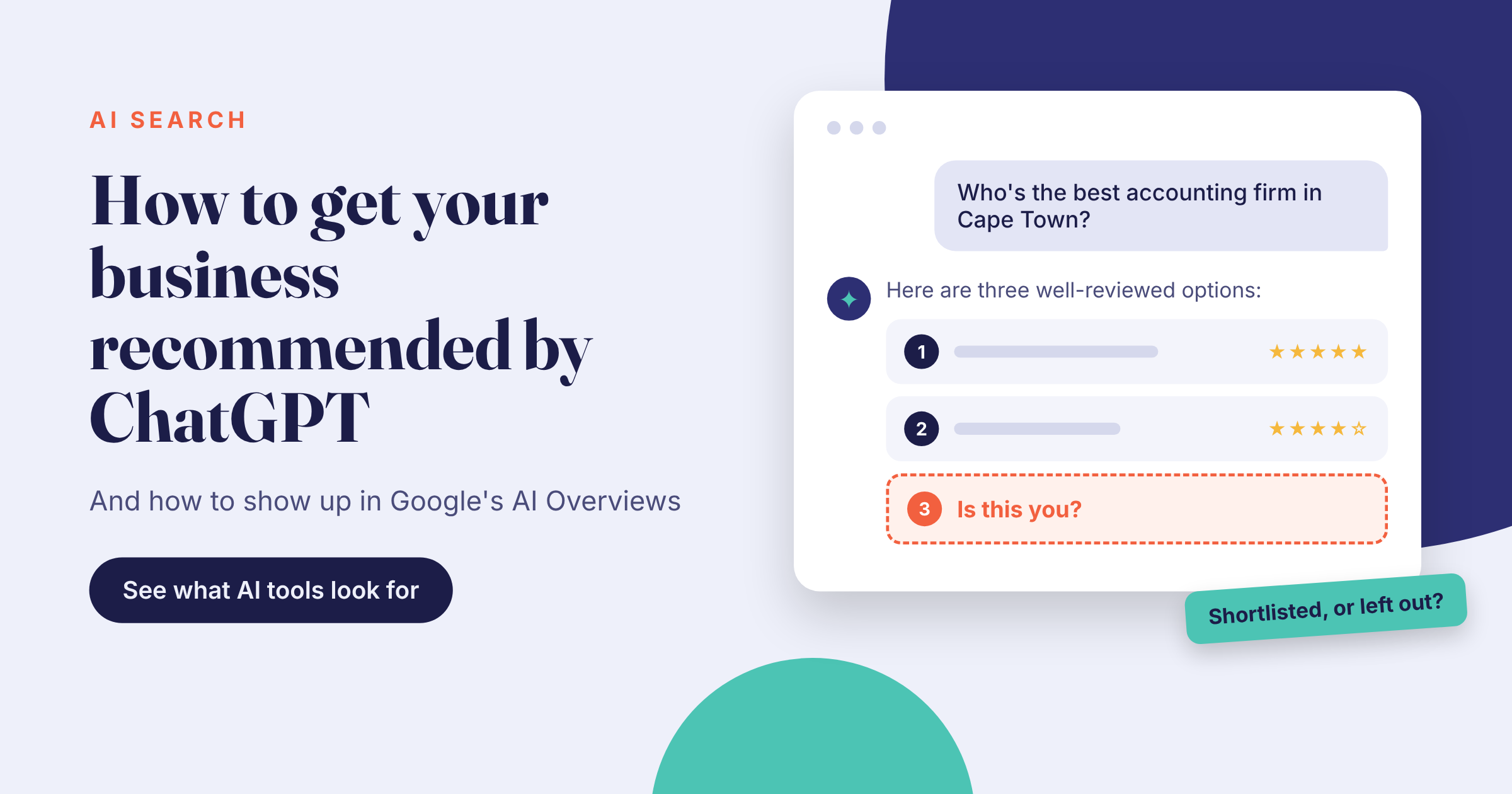
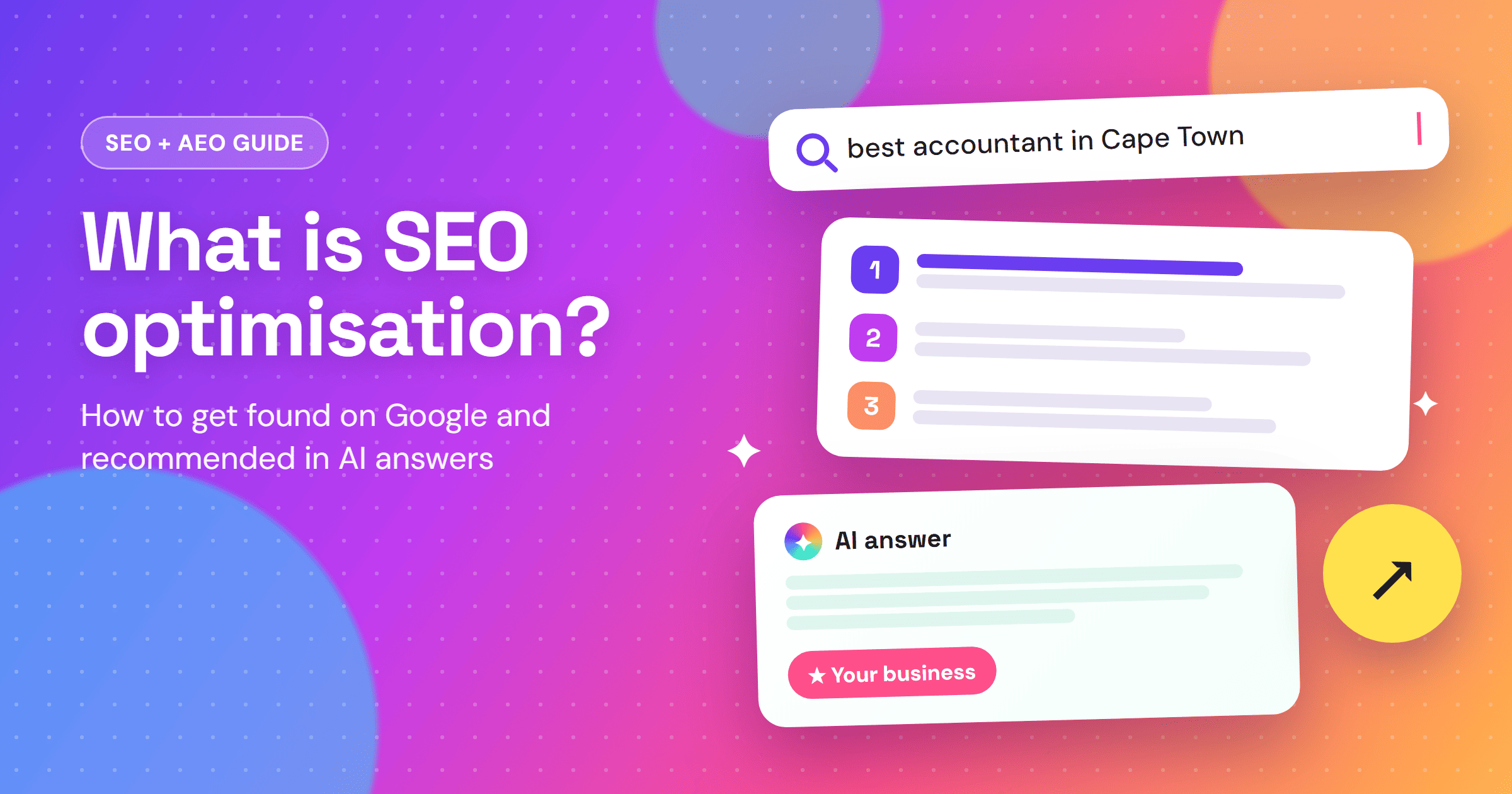
If you want to know how to get your business recommended by ChatGPT, start with what your buyers see. Ask it “Who’s the best accounting firm in Cape Town?” and it won’t give you ten blue links. It gives you a shortlist of three to five names, with a reason for each.
If your business isn’t on that list, you’re not in the running. Worse, you’ll never know you lost the enquiry, because it doesn’t show up in your analytics or your Google rankings.
This is happening at scale. ChatGPT has 900 million weekly users (OpenAI, February 2026), and Google’s AI Overviews reach over 2.5 billion people a month (Google, May 2026). This article explains how ChatGPT and Google’s AI answers choose which businesses to mention, and what you can influence.
We’re Lead Legends, a boutique, owner-led digital marketing agency in Cape Town. Through our SEO and AEO service for South African businesses, we help B2B and service businesses get found on Google and named by AI tools.
Can you get your business recommended by ChatGPT?
Yes, but you can’t pay for it or submit your business to be listed. ChatGPT and Google’s AI Overviews recommend businesses they can find, understand and trust. You influence that by making your website easy for AI tools to read, being clear about what you do and where, answering the questions your buyers ask, and being mentioned on other trusted websites.
The rest of this article explains each of those in turn.
How do ChatGPT and Google AI Overviews choose which businesses to mention?
Neither tool keeps a list of “approved” businesses. Each one builds its answer from what it can find about you, and from what others say about you.
Where ChatGPT gets its answers
ChatGPT draws on two sources:
- Its training data: a large snapshot of the web, books and other text it learned from. If your business was rarely mentioned online when that snapshot was taken, ChatGPT may not know you exist.
- Live web search: for questions like “best IT support company in Durban”, ChatGPT often searches the web in real time and cites the pages it used. OpenAI uses its own crawler, OAI-SearchBot, to find pages for these answers (Search Engine Roundtable).
Live search is the part you can influence most quickly, because it reflects what’s on the web today.
How Google picks sources for AI Overviews
AI Overviews are built from Google’s own search index. Google says that to appear as a link in an AI Overview, a page must be indexed and eligible to show in Google Search with a snippet, and that there are no extra technical requirements or special code to add (Google Search Central).
In other words, if Google doesn’t rank or trust your page, it won’t use it in an AI answer either.
What they have in common: findable, clear and trusted
Both tools are trying to give a confident answer. They lean towards businesses that are:
- Findable: their website can be crawled and indexed.
- Clear: it’s obvious what they do, who for and where.
- Trusted: other reputable websites mention them.
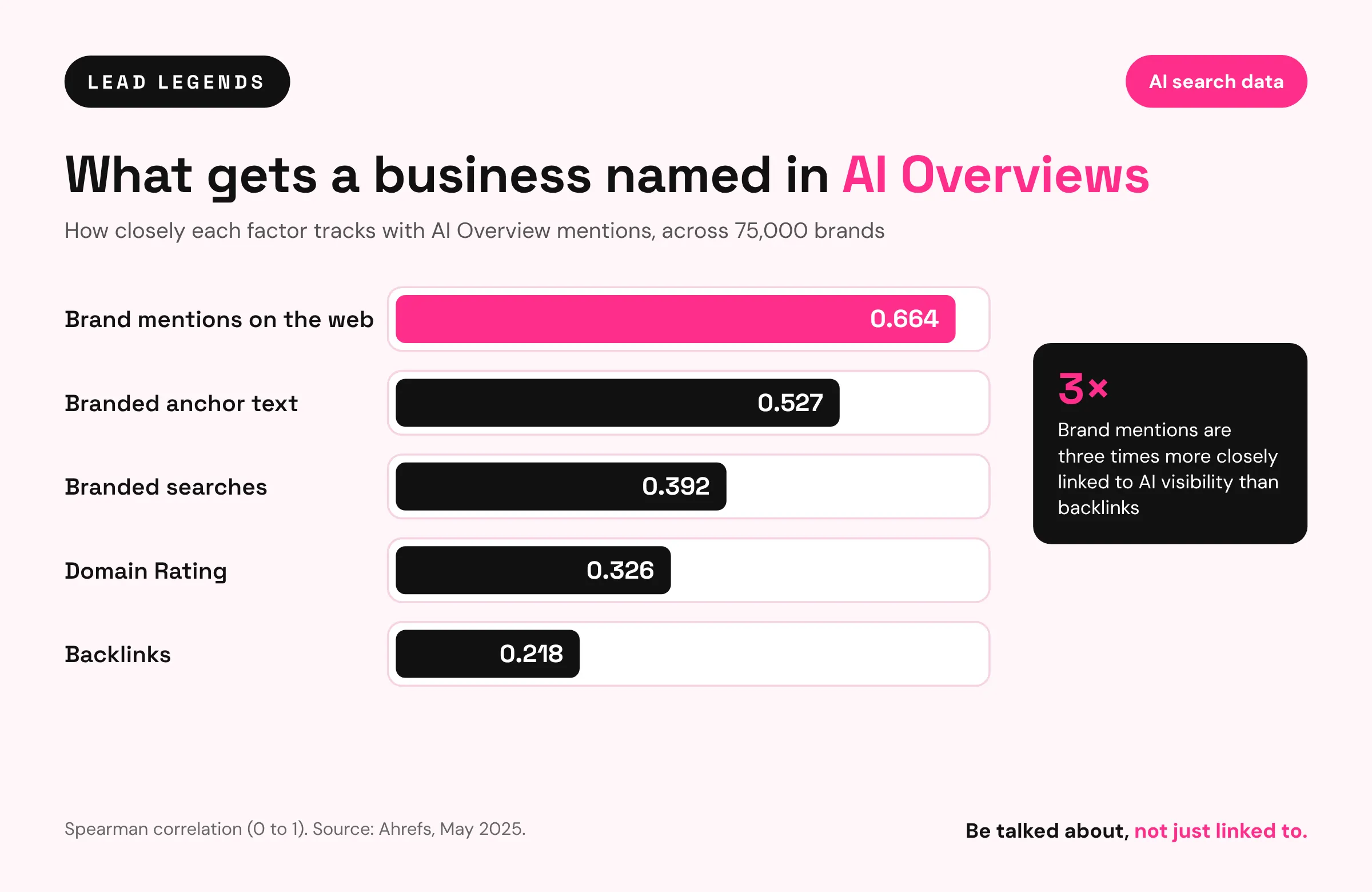
That last point matters more than many business owners expect. An Ahrefs study of 75,000 brands found that mentions of a brand across the web were the factor most closely linked to appearing in AI Overviews (a correlation of 0.664), well ahead of backlinks (0.218).
How to get your business recommended by ChatGPT: 5 things that matter
These five areas shape whether AI tools recommend you. Each one is something you can check on your own business today.
1. Let AI tools read your website
Some websites block AI crawlers without the owner knowing, often through a security setting or an old robots.txt file. If OAI-SearchBot or Googlebot can’t reach your pages, those pages can’t be cited.
It’s also worth making sure your website is registered with Google Search Console and Bing Webmaster Tools, so search engines know it exists.
2. Say clearly what you do, who you do it for and where
AI tools match businesses to questions. If someone asks for “a bookkeeper for small construction companies in Pretoria”, the businesses that say exactly that on their website have an advantage.
Vague homepage lines like “solutions that drive growth” give an AI tool nothing to work with. Name your services, your ideal clients and the areas you serve on your key pages, in the words your buyers use.
3. Answer the questions your buyers ask
ChatGPT and AI Overviews are answering questions, so they need pages that answer them well. Think about what prospects ask you before they buy:
- How much does it cost?
- How long does it take?
- How do I choose between providers?
- What’s the difference between option A and option B?
Pages that give a direct answer in the first sentence or two, then explain, are easier for AI tools to quote.
4. Get mentioned on sites AI tools already trust
This is the step most businesses skip, and the Ahrefs data above shows why it matters. AI tools give more weight to what others say about you than to what you say about yourself.
Useful places to be mentioned include:
- Review platforms, starting with your Google Business Profile
- Industry directories and associations relevant to your field
- “Best of” and comparison lists for your service and city
- Local and trade press, podcasts and guest articles
- Community discussions where your buyers ask for recommendations
5. Keep your business details the same everywhere
If your website says you’re in Bellville, your Google Business Profile says Cape Town CBD, and an old directory lists a number you no longer use, AI tools get mixed signals. Consistent names, addresses, phone numbers and service descriptions make it easier for them to recommend you with confidence.
How to appear in Google AI Overviews
Getting into AI Overviews follows the same principles as ChatGPT, with one big difference: Google tells you exactly where it starts.
Why ranking on Google comes first
Because AI Overviews only link to pages that are indexed and eligible to show in normal search results, good SEO is the entry ticket. If you’re new to how that works, our article on what SEO optimisation is and how it works covers the basics, including how SEO and AEO fit together.
Write answers Google can lift into an overview
AI Overviews pull short, clear explanations from pages. You make that easier when you:
- use headings phrased as questions your buyers ask
- give the answer straight after the heading, before the detail
- use lists and tables for steps, comparisons and prices
- keep facts accurate and up to date
Does every Google search who an AI Overview?
No. Google decides when an AI Overview appears, and many searches don’t trigger one. In a Pew Research Center study of US users’ searches in March 2025, 18% of Google searches produced an AI summary.
They tend to appear for questions and research-style searches, rather than for searches like a brand name. So the aim isn’t to get an AI Overview for every keyword, but to be a source Google cites when one does appear for the questions your buyers ask.
That matters, because AI answers change how people click. In the same Pew study, people clicked a normal search result on 8% of visits when an AI summary appeared, compared with 15% when it didn’t. Being named inside the answer is becoming as important as ranking below it.
Can you rank on ChatGPT the way you rank on Google?
Not in the same way. People search “how to rank on ChatGPT” expecting a position one, but ChatGPT doesn’t have one.
Why there’s no “position one” in ChatGPT
ChatGPT writes a new answer each time. The businesses it names can change depending on:
- how the question is worded
- the details someone gives (location, budget, industry)
- whether it searches the web for that answer
- what it already knows about the person asking
So rather than chasing a ranking, the goal is to be one of the businesses ChatGPT names consistently across the many ways buyers ask about your service.
How to check whether ChatGPT recommends you today
You can run a quick test in five minutes:
- Write down five questions a buyer might ask before hiring a business like yours, e.g. “Who are the best [service] providers in [city] for [type of client]?”
- Ask each one in ChatGPT, and in Google with AI Mode or an AI Overview if one appears.
- Note which businesses are named, and which websites are cited as sources.
- Repeat the same questions in a month.
If competitors keep appearing and you don’t, look at where they’re mentioned. That usually shows you the gap.
Common myths that keep businesses out of AI answers
The biggest myth behind all of these is that AEO is a shortcut around SEO. It isn’t. You can’t optimise for ChatGPT directly. You optimise for the sources ChatGPT trusts, and your own website is only one of them.
“You can pay to be recommended”
There’s no paid placement in ChatGPT’s organic answers or in Google’s AI Overviews. Anyone selling a guaranteed AI mention is selling something they don’t control. If you’re comparing agencies, here’s how to choose an SEO company in South Africa you can trust.
“You need a separate website for AI”
AI tools read the same website your customers do. A clear, well-built website that ranks on Google is the foundation for both.
“One technical file will fix it”
Some articles suggest a single file or tag will get you into AI answers. Google says AI Overviews need nothing beyond normal SEO best practice, and no single file can make up for a business that isn’t mentioned anywhere else.
Is your business ready for AI search? A 5-point self-check
Answer yes or no to each:
- Can AI crawlers reach your website? You’ve checked your robots.txt and security settings, and you’re not blocking OAI-SearchBot or Googlebot.
- Does your website say what you do, who for and where? Someone reading your homepage could describe your business in one sentence.
- Do you have pages that answer your buyers’ questions? Not only service pages, but answers on cost, process and how to choose.
- Are you mentioned on other trusted websites? Reviews, directories, lists or press, beyond your own site and social profiles.
- Did ChatGPT name you in the five-minute test? For at least one of the questions your buyers ask.
If you answered “no” to two or more, AI tools are likely recommending your competitors instead of you. The fix is usually a mix of SEO, clear content and getting your business mentioned in the right places. If you’re weighing up the cost, here’s what SEO packages in South Africa typically include.
Want to know where you stand?
AI search is new, but the businesses that show up in it are the ones that started early. If you’d like a clear view of whether ChatGPT and Google’s AI answers mention your business, and what’s holding you back, we’ll walk you through it.
Questions People Ask
Does ChatGPT use Google to find businesses?
Not directly. ChatGPT uses its training data and its own web search, which relies on OpenAI's crawler and other search providers. Google's AI Overviews use Google's own index. Strong SEO helps with both, because both reward clear, trusted websites.
How long does it take to show up in AI answers?
It depends on where you're starting from. Changes to your own website can be picked up by live search within weeks, but building mentions on other websites takes longer. If your business already ranks well on Google, you're likely closer than a business starting from scratch.
Is AEO different from SEO?
AEO (answer engine optimisation) focuses on getting your business named in AI answers, while SEO focuses on ranking in search results. They share the same foundations. Our article on SEO and AEO explains where they overlap and where they differ.
Should I hire an agency to help with AI search?
If you don't have time to manage it yourself, an agency can help, but check that it covers AI search as well as Google. Our checklist on how to choose an SEO company in South Africa includes the questions to ask, and our article on SEO costs in South Africa shows what a good package includes.