
How Long Does It Take to Build a Website? Realistic Timelines
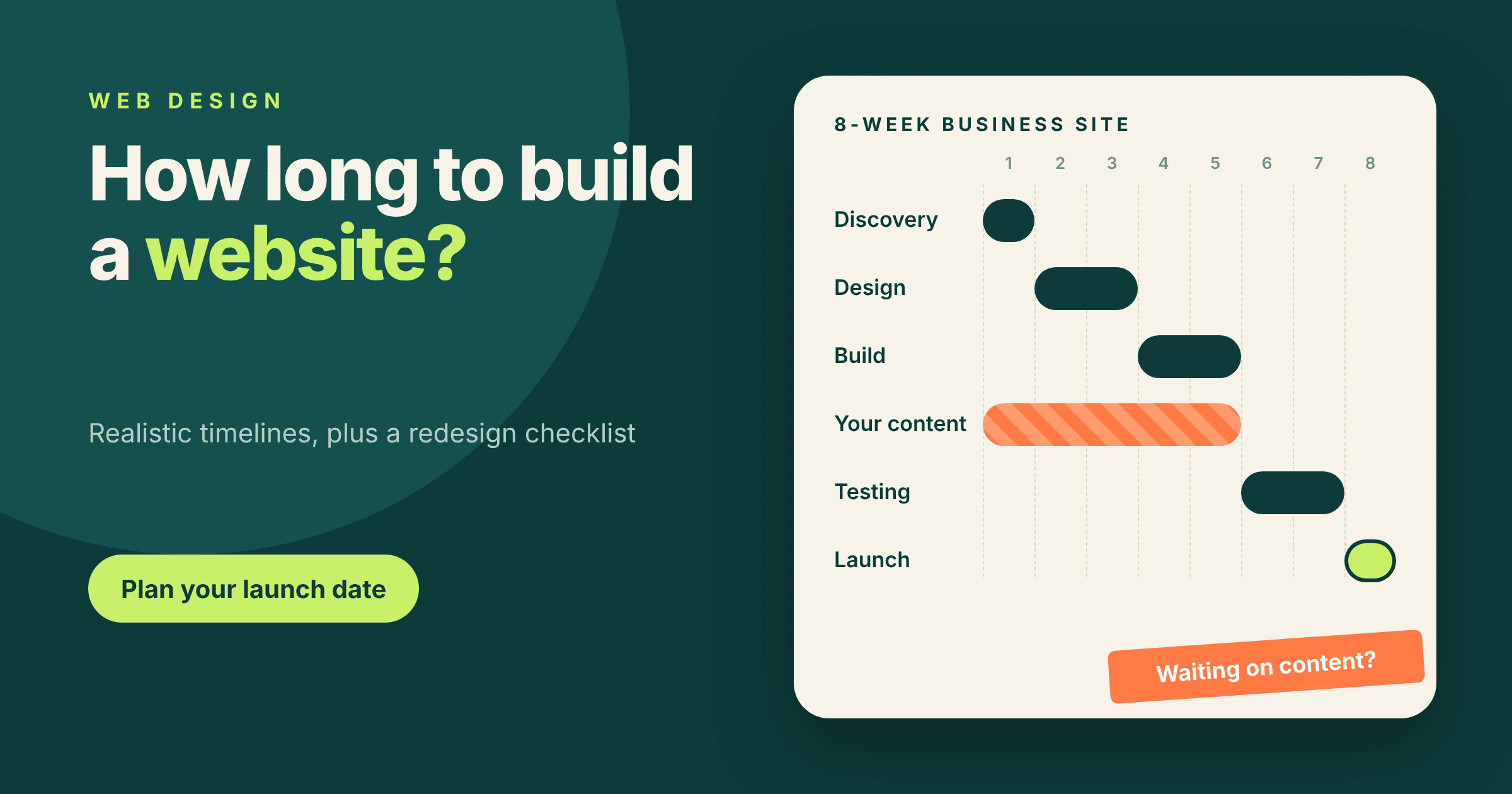
How long does it take to build a website? For most business sites, 3 to 8 weeks from signed-off brief to launch. Online stores take 4 to 12 weeks, and custom web applications take months.
Ask three designers and you’ll hear “two weeks”, “six weeks” and “three months”, usually with no reasons attached. Pick the wrong one and the ad budget is already booked, the stock is already ordered, and the site isn’t ready.
This article gives you realistic build timelines by site type, shows where the time actually goes, and ends with a website redesign checklist so nothing slips between old site and new. By the end, you’ll be able to pick a launch date you can actually keep.
How long does it take to build a website?
The honest answer is “it depends”, but only on a short list of things you can see in advance.
Website build timelines at a glance
| Site type | Typical timeline | What’s included |
|---|---|---|
| DIY or AI site builder | Hours to 2 weeks | Template-based, 1 to 5 pages |
| Business website | 3 to 8 weeks | Custom design, CMS, 5 to 15 pages |
| Ecommerce store | 4 to 12+ weeks | Basic store about 4 to 6 weeks; complex stores 6 to 12 |
| Custom web application | 3 to 9+ months | Simple app about 3 months; complex platforms 9+ |
Source: ProCompare, “Website development timeline South Africa”.
Why the honest answer is “it depends on you as much as the designer”
The design and build usually take a fixed number of weeks. The part that stretches is the waiting: for your copy, your photos, your feedback and your sign-off.
That is why two identical projects can launch 6 weeks apart. One client sends content on day 3. The other sends it in week 5.
Where the time actually goes
A professional build follows the same six phases whatever the size. Here is what an 8-week business site looks like.
Phase by phase: discovery to launch
| Week | Phase | What happens |
|---|---|---|
| 1 | Discovery and scope | Goals, sitemap, features and a written scope |
| 2-3 | Design | Wireframes, then mockups you approve |
| 4-5 | Build | Pages, CMS and integrations are developed |
| 6 | Content and testing | Your copy and images go in; the site is tested on phones and browsers |
| 7 | Revisions | Final fixes (not new features) |
| 8 | Launch | Pre-launch checks, go live, monitoring |
Source: ProCompare 8-week case study.
Why most delays happen on the client side
Late content, slow feedback and scope creep cause most overruns. ProCompare calls delayed content “arguably the number one cause of project delays.”
Agencies add delay too: rushed discovery, overbooked teams and poor communication. Ask any designer how they protect your timeline, not just how long they say it will take.
Website timelines by type of site
Brochure and small business website
A custom business site of 5 to 15 pages takes 3 to 8 weeks. A simple one-page site can be faster.
The range depends mainly on how many pages you need and how ready your content is.
Ecommerce and Shopify store
An ecommerce store takes 4 to 12+ weeks, and the product catalogue is the biggest variable.
How long does it take to build a Shopify website? One published article puts a basic store on a template at 1 to 2 weeks, a standard customised store at 4 to 8 weeks, and a complex store at 8 weeks or longer. Content such as product pages, photos and copy can run in parallel with development, which is the best way to shorten it.
Source: Digital Suits, “How long does it take to build a Shopify website?” (Nov 2023).
Payment gateway and merchant account approval can also hold up a launch, because the vendor sets that timeline, not your designer. Start those applications in week 1.
Custom or web app build
Custom web applications run from about 3 months for a simple app to 9+ months for a complex platform. Integrations with other systems and data migration drive most of that time.
What speeds a website project up, and what slows it down
Speeds it up:
- Content, images and logo ready at kickoff. Late content is the most common cause of delay.
- One decision-maker. Feedback from five people on one page adds rounds.
- A feedback deadline. Agree on a 48-hour turnaround for approvals up front.
Slows it down:
- Scope creep. Every “while we’re at it” feature adds weeks.
- Third-party integrations that are added late (bookings, CRM, payments).
- Migrating data from an old system.
Website redesign checklist
A redesign is where launches go wrong, because the old site already has rankings and traffic to lose. Use this checklist from kickoff to launch.
Before you start
- Audit the current site. Note which pages get traffic and enquiries.
- Set a goal. For example, more enquiries, faster load or a cleaner look.
- List what to keep. Top-performing pages, strong copy and reviews.
- Back up the old site so you can roll back.
During the build
- Map every old URL to a new one. Pages that change address need a redirect.
- Move your content and decide what to rewrite or drop.
- Check the new structure for clear navigation and a page for every service.
- Confirm you own the domain and hosting login.
Before launch
- Test on phones and major browsers. Check every form and button.
- Set up page titles, descriptions and headings on every page.
- Check page speed and compress images.
- Install analytics and tracking, and test your enquiry forms.
- Test the redirects from the old URLs.
After launch
- Submit the new sitemap to Google Search Console.
- Watch for crawl errors and 404s in the first weeks.
- Compare traffic and enquiries against your pre-launch audit.
- Fix broken links and missed redirects quickly.
Redirects and on-page set-up are what protect the rankings you already have. Our article on what SEO optimisation is explains why.
How to plan your launch date
Work backwards from the date you cannot miss.
- Pick the hard date. A campaign, season or product launch.
- Subtract the build time for your site type (use the table above).
- Add a buffer of 2 weeks for content and feedback delays.
- Set your own deadlines for content and approvals, and treat them as part of the schedule.
Example: if you need to launch by 1 March and your business site is an 8-week build, plus a 2-week buffer, kickoff needs to be by 21 December.
Timeline is half the planning. For the other half, see website design cost in South Africa.
Got a launch date in mind? See how Lead Legends website design and development service scopes your site and maps the timeline before work starts.
Questions People Ask
How long does it take to build a website from scratch?
Most business sites launch within 3 to 8 weeks of a signed-off brief. Ask for the timeline in writing, with a date beside everything you need to supply.
How long does a website redesign take?
Plan for roughly the same time as a new build. Allow extra time to map old URLs to new ones, because redirects protect the rankings you already have.
What slows down a website project the most?
Late content and slow feedback. Send your copy and images before kickoff and name one person to approve each stage.